
A warehouse management system (WMS) built around your warehouse.
Receiving, put-away, picking and dispatch all run in the same environment. One stock figure, live, down to the location and the individual action.
From dock to departure.
In most warehouses these four steps run through three systems that keep each other posted with exported files. Here it is one flow.
Receiving
Pre-advised shipments are scanned in, counted and checked. Film off, pallet broken down, and any discrepancy recorded on the line it belongs to.
Put-away
The system picks the location based on turnover, weight, shelf life and what is free. The forklift driver gets the instruction, not the puzzle.
Picking
Pick instructions follow your order profile, not the other way around. Per order, in batches, by zone or in waves, with walking routes the system works out.
Check and dispatch
Weigh, check, label and load in the order the lorry has to be unloaded. Packing slip and invoice lines come out of the same order.
Picking that matches your orders.
One warehouse picks a thousand lines for twenty customers, the next picks twenty lines for a thousand. That calls for different logic, not a different supplier.

Batch, zone and wave
Bundle orders that share the same aisles, split them by zone and time your waves to the departure slot of the lorry. The strategy is a setting, not a rebuild.
Walking routes that make sense
Pathfinding sets the order of the pick list, so your people walk the shortest route and never have to double back through the same aisle.

Instructions on the floor
Handheld scanner, voice or colour signal: staff get the instruction in whatever form works at that spot. Confirmation is a scan, not a clipboard.
Trolleys in the right order
The system works out the stacking sequence, so what belongs at the bottom ends up at the bottom and the trolley is right first time when it reaches the customer.
Stock that adds up, without a counting week.
Every movement comes from an action: a scan, a weighing, an order. So your stock is not a snapshot from last month, it is where things stand right now.
- Cycle counting in the background, scheduled per location
- Every movement traceable to an action, a person and a timestamp
- Discrepancies visible the moment they appear
- Replenishment on forecast demand, based on usage, lead time and season
What plugs into the floor.
Core has a built-in local devices manager. Hardware connects natively, with no layer from an outside integrator in between.
Scanners and handhelds
Pick, count and check instructions on the screen in the aisle, reporting straight back.
kg
Weighing scales
Weight per parcel or pallet arrives as a measurement and carries through to packing slip, freight and invoice.
^XA ^FO50,50 ^ADN,36,20 ^XZ
ZPL label printers
Shipping and product labels roll out of the printer at the right station, at the right moment.

Conveyors and sorters
Belts, pushers and scan points respond to your order flow in real time.
Sensors and cameras
Temperature, weight, presence and vision arrive live in your flows.

Robots and cobots
From pick-and-place to an autonomous cell, with native blocks for DOBOT among others.
Want to see this running in production?
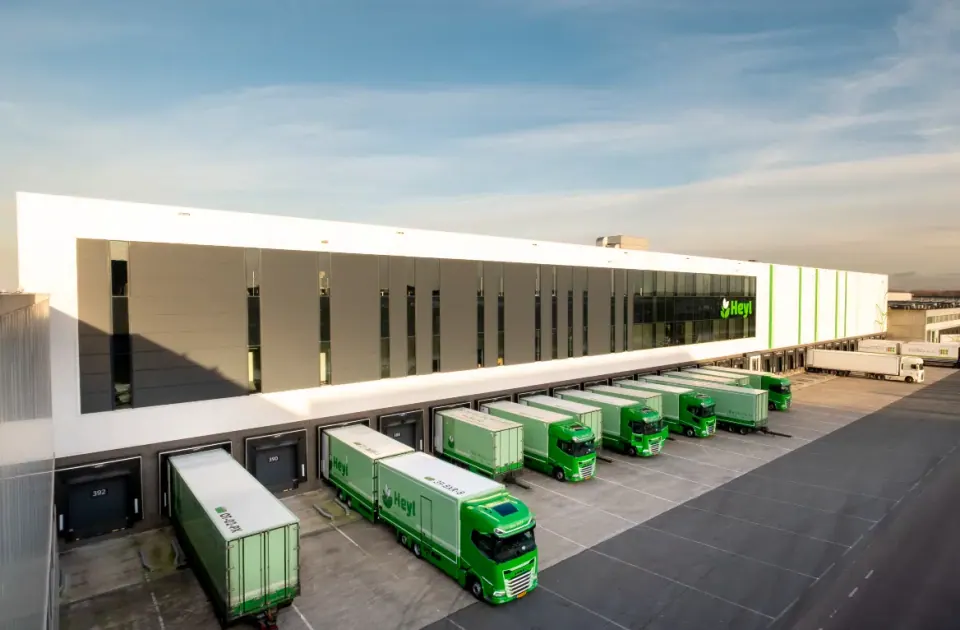
At W.K. Heyl Jr. order processing, stock and the sorting line run entirely on Core, in a 26,600 m² warehouse.
More on warehouse.
Conveyors and sorters
Real-time control of belts, pushers, scan points and label printers, from the same flows as your orders.
See the control layer
Administration
From order to paid invoice, connected to Exact, Mollie and SEPA.
See administration
Robotics
Pick-and-place, vision and autonomous cells, driven from the same system as your warehouse.
More on robotics
The questions we get most about a WMS
Will it fit our order profile?
One warehouse picks a thousand lines for twenty customers, the next picks twenty lines for a thousand. Picking strategy is a setting here: per order, in batches, by zone or in waves, with walking routes the system works out.
How does the stock stay correct?
Every movement comes from an action: a scan, a weighing, an order. Cycle counting runs in the background, scheduled per location, and discrepancies are visible the moment they appear. A counting week is no longer needed.
Does the WMS drive our equipment too?
Yes. Scanners, scales, ZPL label printers, conveyors and robots connect natively through the local devices manager in Core, with no layer from an outside integrator in between.
What does a custom WMS cost?
The build is billed by the hour, with project work itemised separately on the invoice. After the blueprint in weeks 2 to 3 you have a fixed price and schedule. The licence the WMS runs on starts at €515 per month.
Is your warehouse running into its limits?
We will spend a day on your floor. After that you know where the gain is, and what it costs to take it.