
Six to twelve weeks, and then it runs.
No year of specifications followed by hope. We build on Core, so from week three you see working software in your own environment.
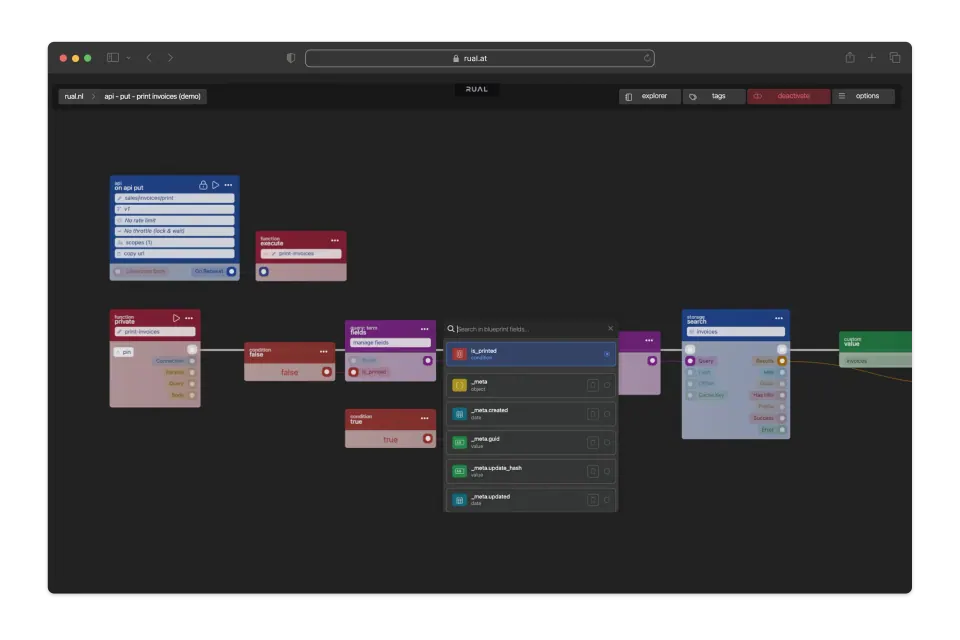
Week by week
Twelve weeks is the upper end. A well-bounded system is often up and running in six. What decides it is not our pace, but how quickly you can make decisions.
Walking the floor
We come by, walk along with the people doing the work and follow one order from start to finish. By the end of the week there is a process map your people recognise themselves in, including the steps nobody ever wrote down.
Blueprint and a fixed commitment
You get the design of the system, the list of integrations and a fixed price with a schedule. From that point you know what you are getting and what it costs. Anything added later is agreed separately, and always in advance.
Your own environment goes up
We stand up your environment on our own hardware in the Netherlands, with the first screens and your real data in it. From here you click along yourself. Not in a demo account, but in the system that will go live.
Building, with weekly demos
Every week a demo of what works, in your environment, with your data. Adjusting happens straight away. Because your process is built as a flow, a change usually takes hours rather than a sprint.
Integrating and running alongside
Accounting, banks, carriers, auctions, scanners and machines come online. Your people run both systems in parallel for a while, so you see with your own eyes that the figures add up before you switch.
Go-live
We migrate your data, stand on the floor or on the phone for the first few days and fix whatever real use turns up. After that the same team stays your point of contact.
What we need from you
This is the only place where a project genuinely runs late. Technology is rarely the problem, availability is.
One decision maker
Someone who settles questions without first convening a steering group of seven. When in doubt we pick the simplest version and adjust it later.
Two people from the floor
The people who actually do the work, roughly half a day a week. They spot in ten seconds what a manager walks straight past.
Access to your data
Your current records and a contact at the suppliers of your existing systems. The sooner we get there, the sooner we know what an integration will cost.
An hour a week
For the demo, with the people who will work in it. Skip those and the comment moves to the final week, where changing course costs more.
What you own once it is live
The question worth asking up front: what do I keep if we go our separate ways?
Your processes, readable
Everything we build sits as a flow in the editor. Your own people can see what the system does and change it, without reading a line of code.
Your data
Your records stay yours and can be exported. No format only we can open.
Your own environment
Hosted on our own hardware in the Netherlands, in ISO-certified data centres. Running it on your own site is possible too.
The documentation that matters
The process map, the design and the integrations, kept in step with how the system looks on the day it goes live.
Support from the builders
Your question reaches the people who built the system, not a service desk working through a script.
Or you carry on building yourself
Some customers want to take the wheel after go-live. That works. We deliver the foundation on Core, your team extends it, and we stay available for the parts that need specialist knowledge, such as hardware control or heavy integrations. The IT team at W.K. Heyl Jr. has been extending their own ERP that way for years.
- Your team learns the flow editor, not a new programming language
- Changes without a release circus or a waiting list
- We step in on the parts that are genuinely specialist
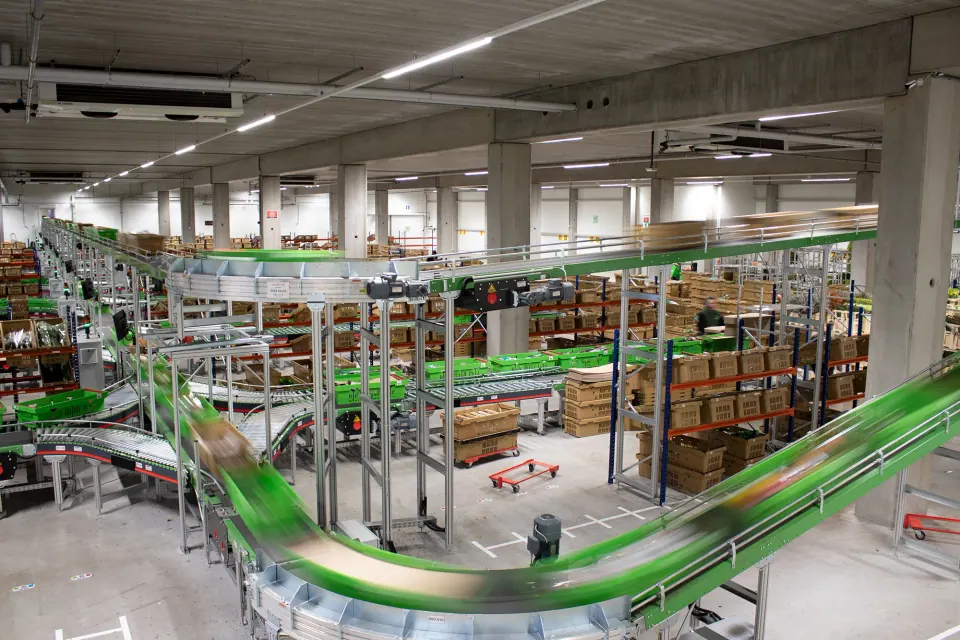
W.K. Heyl Jr.: their own team, their own roadmap, on Core
What we build in a project like this
From the system that carries your whole operation to the control of a sorting line. Usually all three at once, because they belong together.
Business software and ERP
Orders, stock, purchasing, planning and invoicing in one system, set up around the way your business works.
More on software
Warehouse automation
From WMS and scanning through to real-time control of conveyors and sorters, including the design of your warehouse.
More on warehouse
Robotics and AI
Vision, agentic robotics and AI applications running on the same data as the rest of your operation.
More on robotics
And what does it cost? The build is a fixed-price project, after which you pay one monthly amount for platform, hosting and support.
How the cost picture worksWant to know what your project would look like?
Tell us what needs to happen and we will tell you whether it is six weeks or twelve.