
Where the money goes, and where it gets stuck
The price of business software is rarely in the quote you sign. It is in the lines that show up afterwards.

The bill has more than one line on it
In the classic model you pay three parties at once: the vendor of the package, the firm that implements it and the firm that keeps adjusting it afterwards. Each has its own pricing model, and those models reinforce one another.
The licence grows with your headcount
Per-user pricing sounds fair until you start growing. Every new employee, every seasonal worker and every supplier you want to give access becomes a recurring line. The predictable result: people start sharing accounts, which is exactly what you do not want in a system with an audit trail.
The hourly rate decides what happens
Once every change is a quote, you start postponing changes. The system slowly falls behind reality, and the small things that cost your people time every day never get fixed, because they do not clear the business case.
Customisation becomes the most expensive layer
Whatever the standard package cannot do gets built around it. That layer rarely has an owner, has to be retested at every upgrade, and is the first casualty when you change supplier.
Every integration is its own project
Accounting, the carrier, the bank, the web shop, the scanners. Where each integration is built separately and maintained separately, you pay for it twice: once to build it and again at every version change on either side.
The upgrade you cannot skip
Stay on an old version and you lose support. Move with it and all your customisation has to move too. Both directions cost money, and neither gives you anything you could not do yesterday.
The rebuild at the end
After a number of years, building on costs more than starting over. Then a project appears on the budget that, at best, brings you back to where you already were.
What changes with one fixed monthly amount
With us you pay per environment for the platform, the hosting and the support. That is not a discount, it is a different model, and it takes six lines off your budget.
Per-user cost
Gone. You pay for your environment, not for the number of people working in it. Everyone gets their own account, including the seasonal worker and the supplier who needs one screen.
Cost after signing
The licence cost is the cost. What we agree at design time is what you get, including the integrations named in that design.
Cost per integration
Integrations belong to the platform. Dozens are ready to use, and a new one gets built in the editor, not as a separate project with its own maintenance contract.
Cost of upgrades
We keep the platform current, with your processes on it. You do not have to move with it and your customisation does not have to be rebuilt.
Cost of separate services
Sending mail, generating documents, processing payments, running reports: that sits in the platform. Not a stack of subscriptions that each get more expensive every year.
Cost of the rebuild
We keep the technical foundation under your business up to date. A rebuild project because the technology expired is not on your budget.
The most expensive line is the change you never make
A price per change looks manageable. What it actually does is stop you changing anything. Your process moves on, your software does not, and your people bridge the gap by hand with exports, intermediate files and arrangements only they know about. None of that appears on an invoice, but it runs every day and it grows with your turnover.
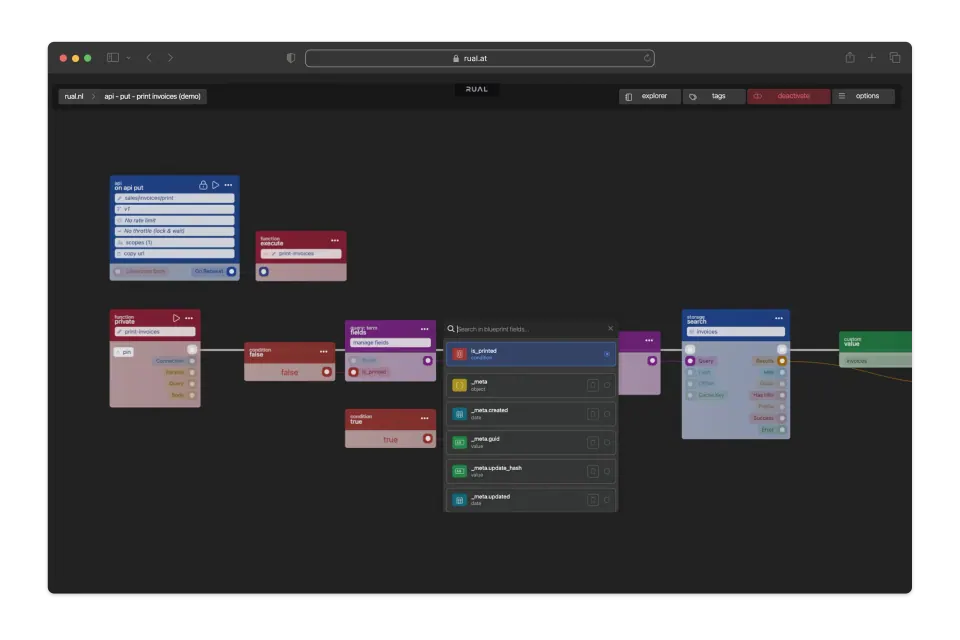
- With us a change is an edit in the flow, not a release plan
- Your own people can see what the system does and adjust it
- Small improvements do not have to clear a business case
Fewer people needed to build the same thing
The difference is not in the hourly rate. It is in the number of hours, and in the coordination between those hours.
A classic custom build takes several times as many developers, for months, and most of that work goes into foundations every company needs and nobody ever sees. On Core those foundations are already there. What is left is your process, and a small team builds that in weeks rather than quarters.
- Users, permissions and roles
- Audit trail and logging
- Integrations and API layer
- Reporting and dashboards
- Hosting, backups and monitoring
- Security management per environment
What you do pay us for
A page about cost that only says everything is cheaper is not honest. This is what does appear on the invoice.
The build itself
Designing and building your system is a fixed-price project. One-off, and you know the amount before we start.
How a project runs
Your monthly licence
Per environment, with the platform, the hosting, the updates and the support included. A fixed amount, known in advance.
See pricing
Extensions you ask for later
A new process or an integration that was not in the original design is agreed separately. Always in advance, never as a surprise on the invoice.
Hardware, where there is any
Conveyors, sorters, scanners and robots come from manufacturers and carry their own price. That runs separately from your software, so you can see what you are spending on what.
More on warehouse
Actual amounts? The price per environment is on the pricing page. All amounts on this site exclude VAT.
See pricingLet us work through your cost picture together
Bring your current invoices, including the ones for hours. We will set alongside them what this costs with us, including the year after.